So they say it’s 33 years ago this week that La Bamba opened.

So they say it’s 33 years ago this week that La Bamba opened. Here’s what I remember.A bunch of us young actors in Dallas had formed a sort of family, mainly centered around a guy named Adam Roarke, but there were other connections. My brother, Bill, was the first to land enough acting work to move to Los Angeles (1982?). With his help, I headed west a couple of years later. Lou was still in Dallas when a national talent search for La Bamba found HIM. As I remember it, he and Esai Morales were set to play the brothers, but it took some time to determine which would be Ritchie. The film wrapped, Lou booked a Miami Vice (Eddie Olmos, impressed, booked him straightaway in Stand and Deliver). Those old enough will remember the power of MTV in the Eighties. Los Lobos played the music in the film, with Lou syncing. Some absolutely excellent videos were assembled, and started playing on MTV ’round the clock. Six-foot cardboard “standees” of Lou/Ritchie appeared in every CD store in America. Mind you, the film hadn’t opened. Lou had already spent his “scale plus ten” salary just living in a little place on Crescent Heights, watching the clock tick. I remember the two of us going bowling about a week before the film opened. Every two minutes, he got interrupted to sign an autograph. We looked at each other, bug-eyed. So this was how it’s going to be. Thirty years on, if I wear my Longmire hat in a grocery store, the checkout girl will tell me she just got Lou’s autograph in the deli aisle yesterday, and how nice he is. You don’t say.

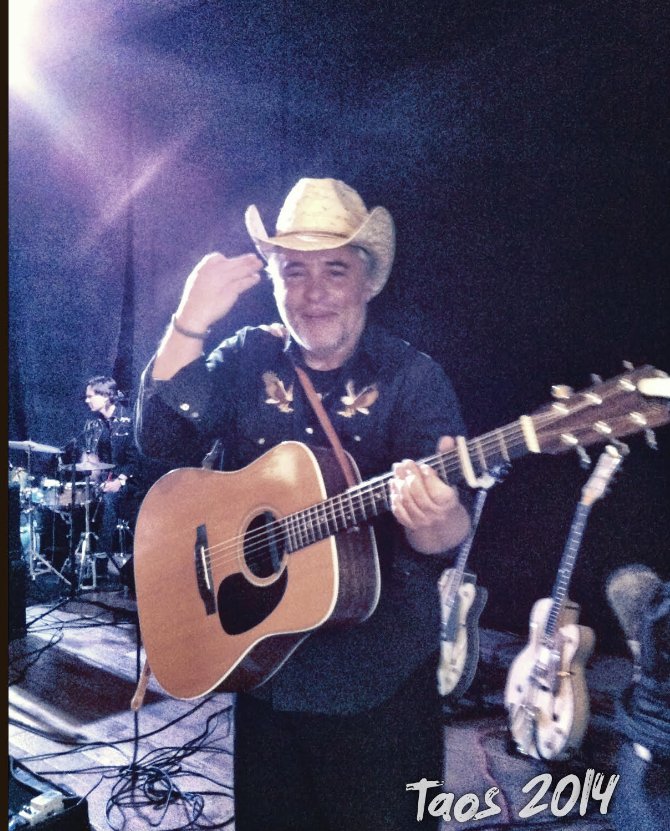
2015 Gigs (mostly) In Santa Fe (Mostly)

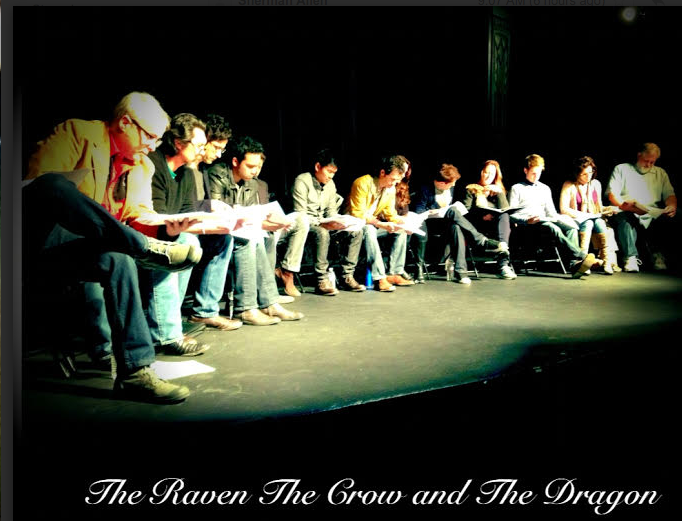
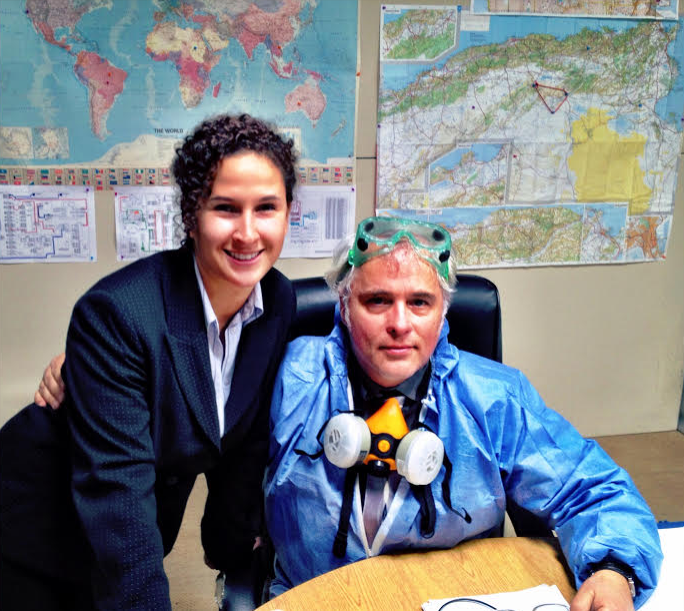
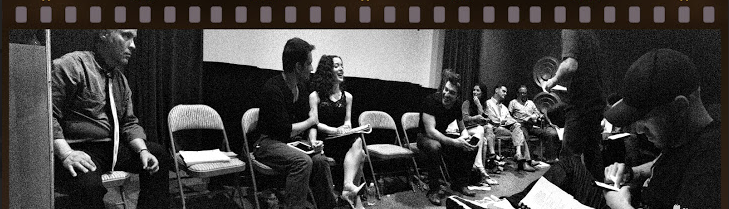
Once upon a time in Hollywood, this guy (Ira Heiden) invited me to participate in a table read

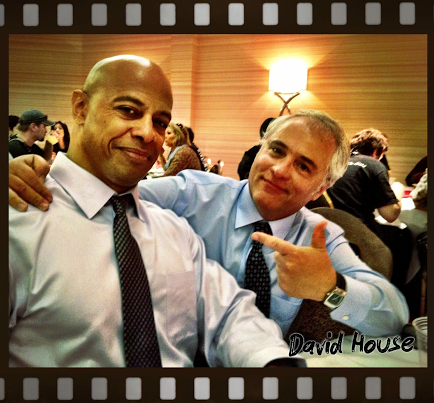
Seated next to this guy…
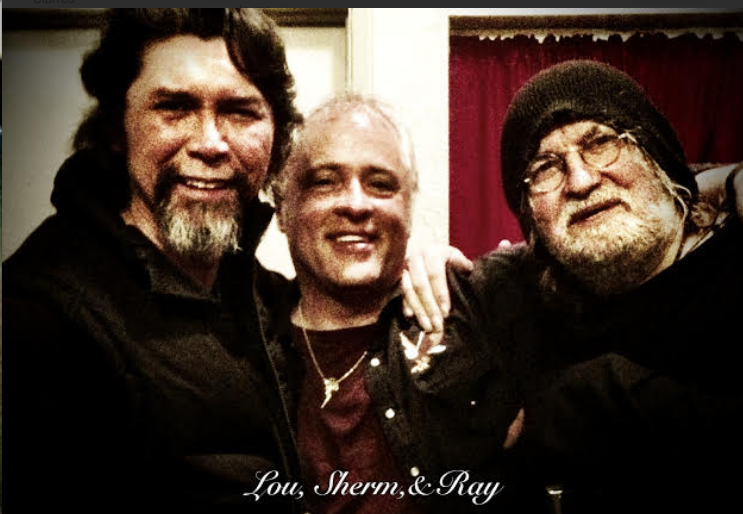
…who then cast me in a movie called “The Tao of Surfing” in Santa Cruz, California, where I introduced Lou to this guy (Ray Wylie Hubbard), who then did a song for our soundtrack.

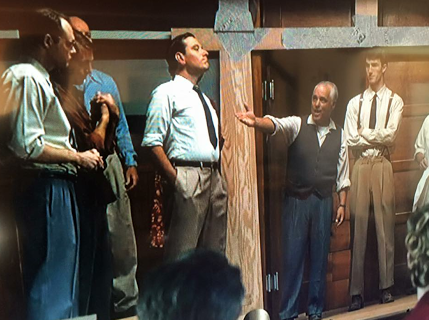
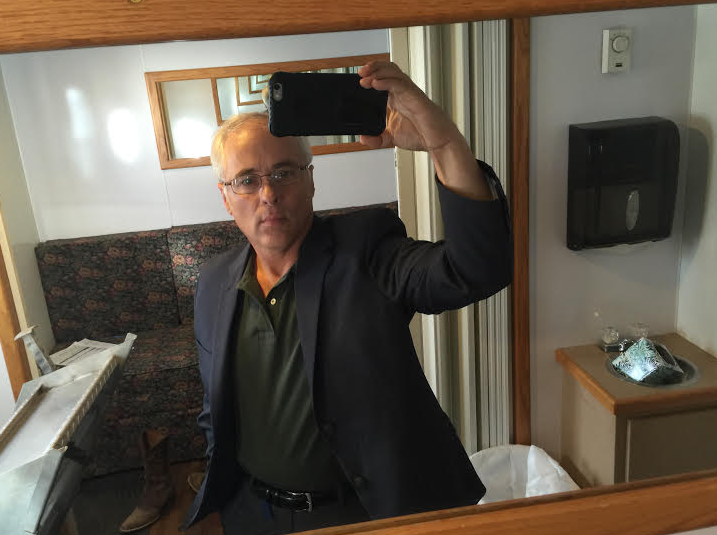
Lou then invited me to Santa Fe where this guy (Robocop’s Peter Weller)…
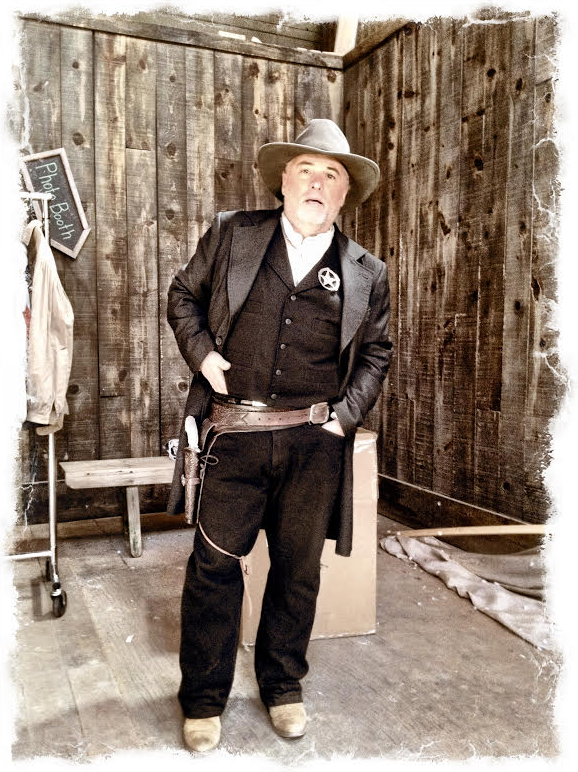
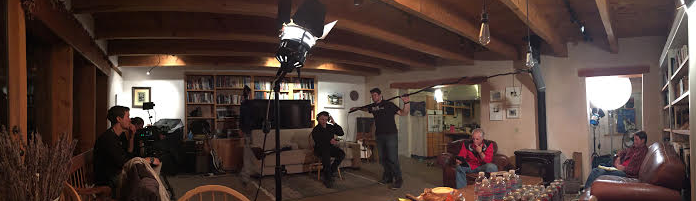
…cast me in Longmire. 
I got hired to play in a Western Swing band, 
“If you’re gonna play guitar, get ready to get fired a lot” -Red Voelkert
More acting gigs materialized 
Arrested Development
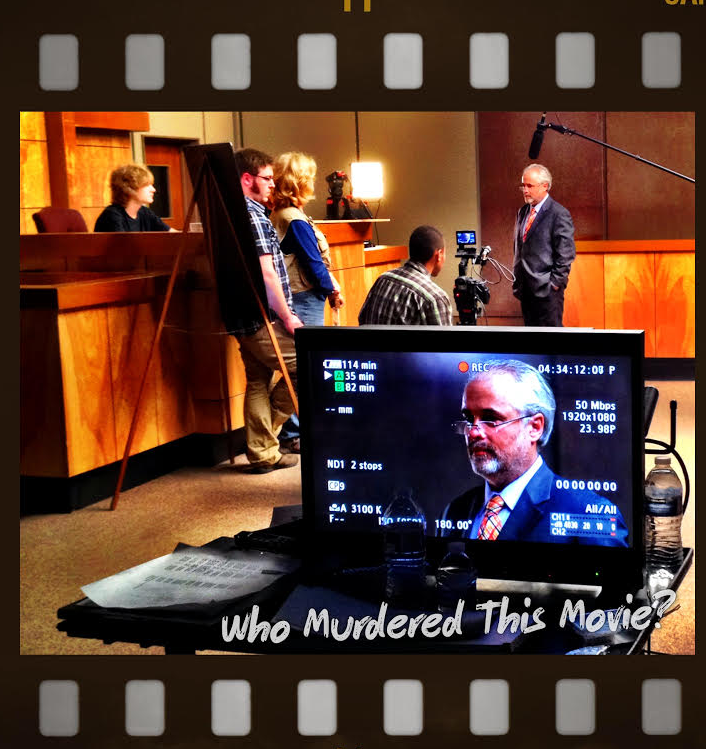
Who Murdered This Movie
Kammler Code
Displacer
Table Read at George RR Martin’s Cocteau Cinema
Spare Parts
Manhattan
A great pilot that I was cut out of, I better not say what
We released The King of Clubs, a tribute to the music of Bugs Henderson, my proudest professional achievement
I found some more Honkey Tonks to play
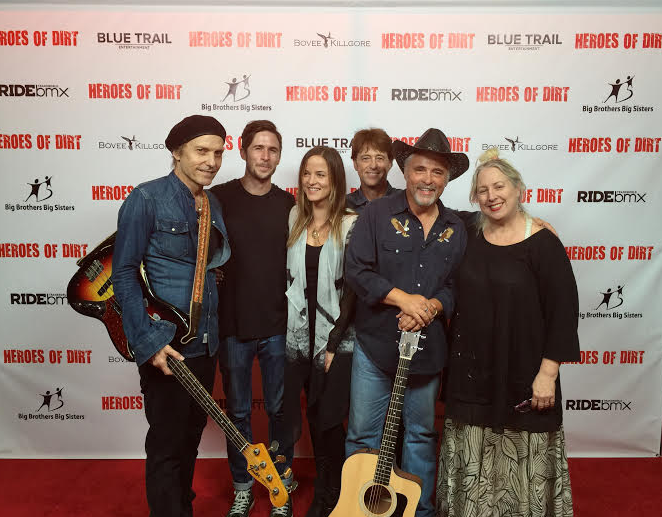
An all-star band at the premiere of my Brother’s film, Heroes of Dirt
Finally, in 2016, 
The Brothers Allen
This one’s a Whopper, legally forbidden to talk about. 
I gotta go call my agent, I’m still waiting on word on a couple of auditions. 

TREMOLO:THE SECRET SAUCE OF TONE

Thinking deeply about tremolo is a “good news/bad news” proposition. It’s sure to make you sound better, but at the risk of giving you a new guitar-related obsession. Which you need like a hole in the head. 


You probably have been told, and rightly, that vibrato is a regular pitch oscillation, whereas tremolo is a volume thing. Check. And musical manufacturers use these words interchangeably, often incorrectly, doing irreparable harm to the English language. Check and Double-check. I say that language is a living thing; and that pickers since the days when Leo was still punching a time clock have been calling a throbbing guitar tone “Tremolo”, and so shall I. Sue me. 

DOPPLER, AND WHY IT’S GOOD


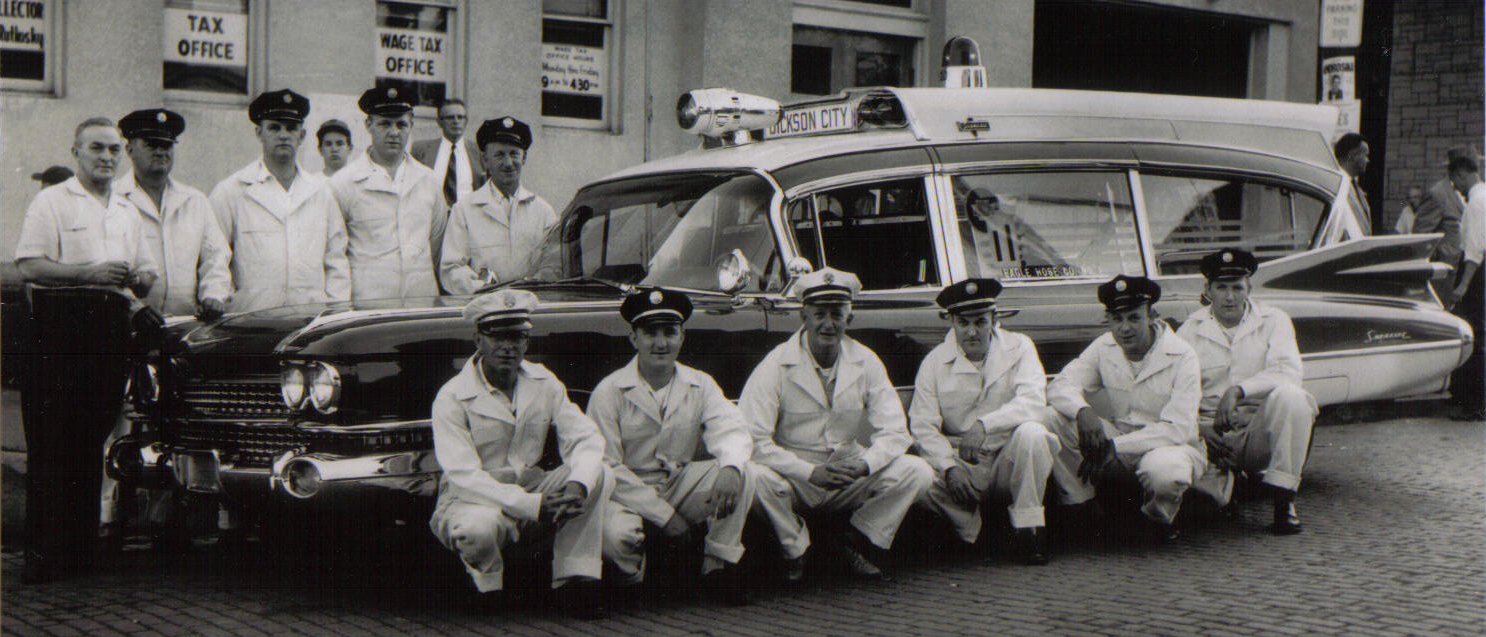
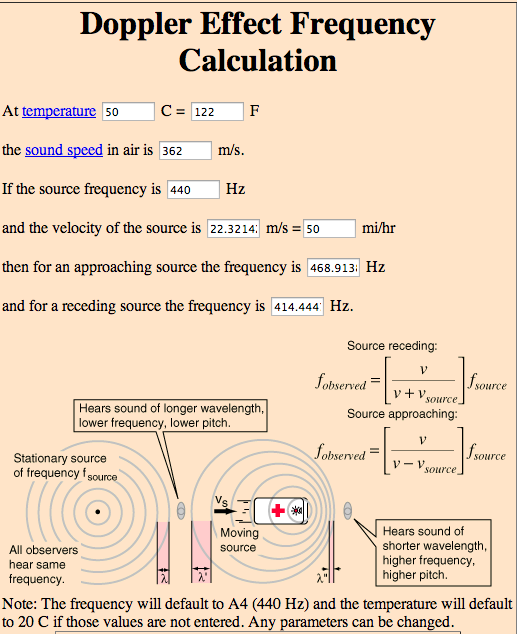
When a sound source moves toward you, the sound waves in the air get all bunched up, and the pitch gets higher. When the fire truck passes you and the siren moves farther away, the waves spread out and the note gets lower.


Christian “Puddin’head” Doppler postulated this in 1842. 
99 years later, the Leslie organ speaker was introduced. 


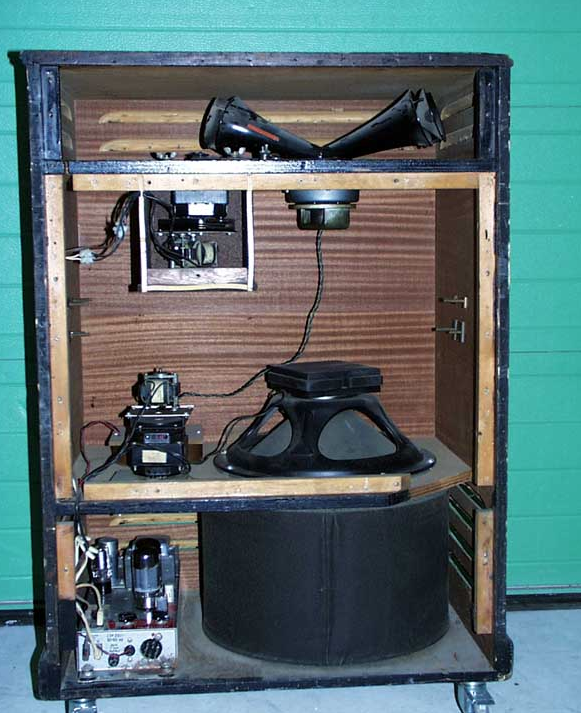
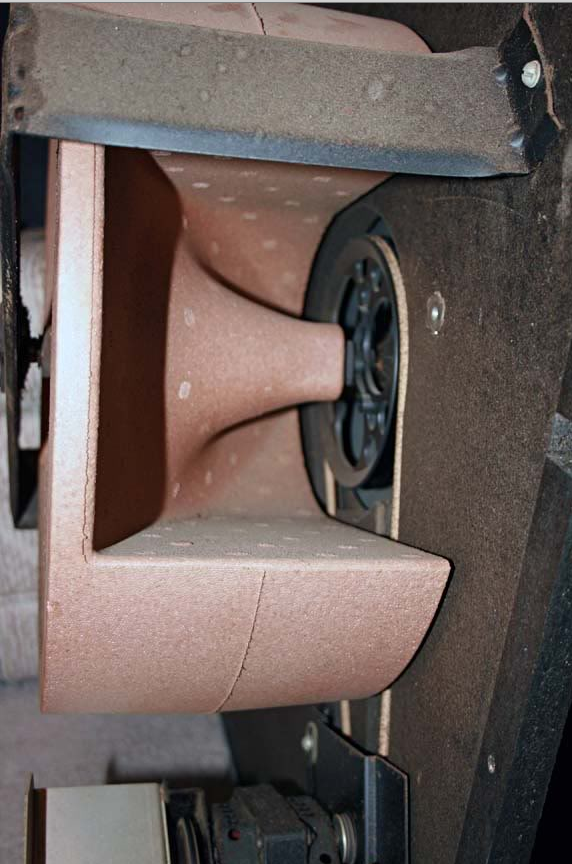
As a mechanical device, it’s a handful. Tweeters whirling on a turntable atop woofer rotors spinning opposite, with belts, pulleys, and foot pedals involved. 
It records great, (John Lennon’s voice was pumped through a Leslie on the psychedelic “Tomorrow Never Knows”, because he asked George Martin to make him sound like a Tibetan monk singing from a mountaintop. To me, it sounds like that Tibetan monk must’ve used a cheap harmonica mic.) and is even cooler to experience live. 

BETCHA DIDN’T KNOW 
CBS/Fender bought Leslie in 1965.
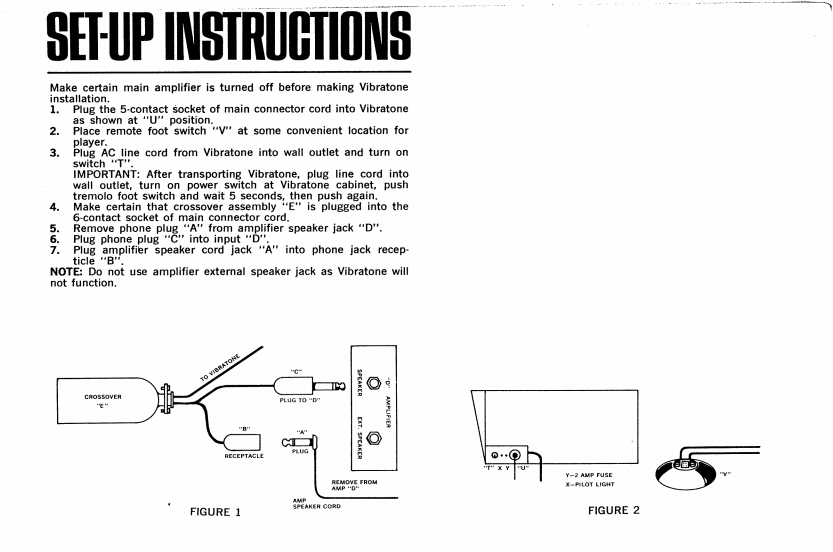
Pretty soon, the Vibratone came along. 


In this, the speaker is stationary, while a spinning styrofoam rotor in front of the speaker squeezes and stretches the air pulses, creating a Doppler effect. Dang clever, I say. 
Harrison used it on everything in ‘69/’70, (Badge, It Don’t Come Easy, Let it Be), Stevie Ray Vaughan used it a lot; very prominently on “Cold Shot”.
There are Leslie Pedals which some folks say gives you the sound. I don’t think it gets you but about halfway there. Those B3 guys don’t carry Leslies around for their health. 


PEDALS: Too many to list

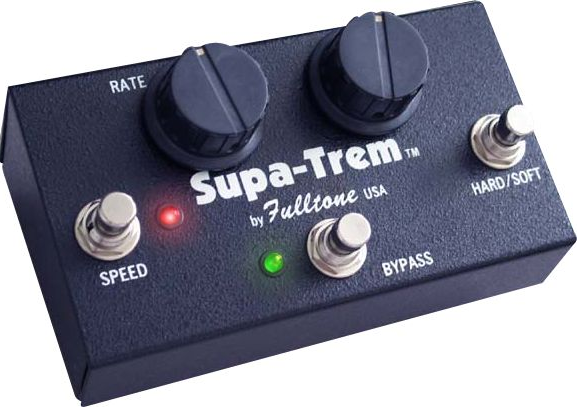
I favor the Supa-Trem, which features:
Blinking Light… so you can time it to the song…
Big-Ass Knobs… you can control with your boots while playing…
Fast/slow Switch… which doubles or halves the pulsation like a Vibratone. 
Hard/soft Switch… for round-wave Fender, or spitty, angry, square-wave Vox


Finally: Tremolo On Guitar Amps …

True Pitch-Changing Vibrato


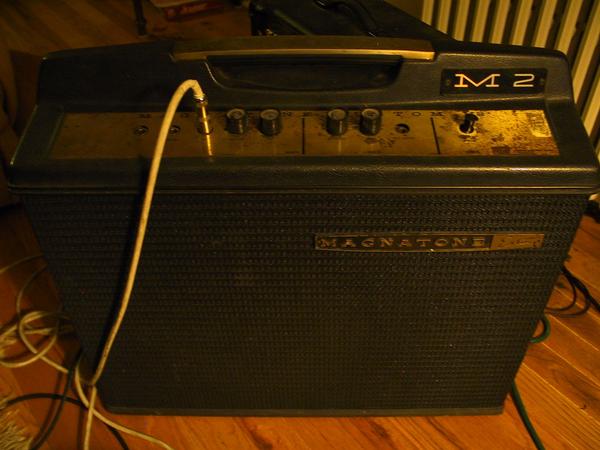
Some Magnatone Amps (Buddy Holly “Words of Love”, Lonnie Mack, “Wham”)

Some Fender Brown Amps
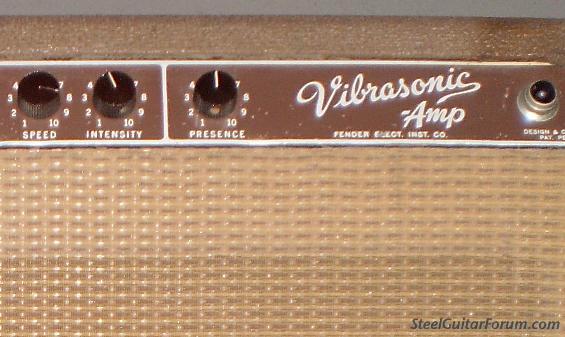
PRO, Vibrasonic
This 6G circuit was complex, not well-received, and therefore short-lived. Sounds WILD. 


NON-Pitch-Changing Tremolo

Bias Modulation and Opto “Bug”

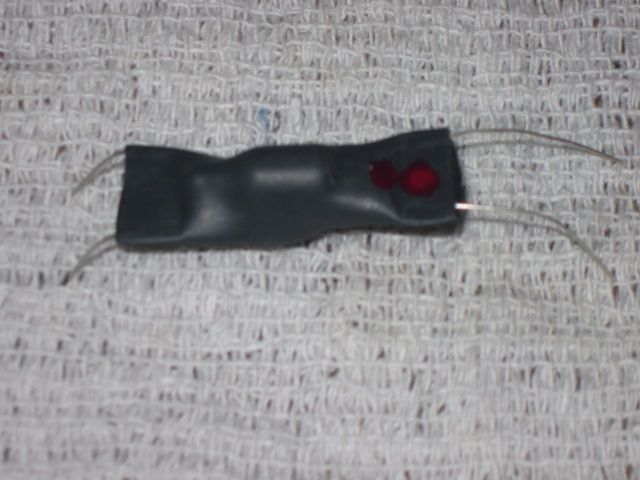
This is not the most fun  conversation, but I’l go there. Tube amps will likely have “Opto” tremolo, the heart of which is a throbbing light bulb next to a light-sensitive resistor inside a dark box or “bug”

 To me, this is the classic clean Fender tremolo, like Buffalo Springfield’s “For What its worth”. Examples: Deluxe Reverb, Twin Reverb, Super Reverb.

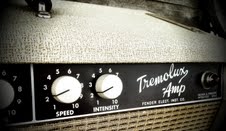
Some amps, usually not very big amps, achieve the pulse by cutting bias power. Not something you’d want to try in a powerful amp. It sounds more like a throbbing car engine. Princetons and Tremoluxes use this. 


The Secret…
Set your tremolo on 2 and 2, and leave it there. Try it at home. It reduces headroom, gives body and texture to your tone, and makes the sustaining final chord cool as all get-out.

 You’re welcome. 
The Helmholtz Frequency of a Wooden Box -or- Never Trust Anything That Used to be a Tree

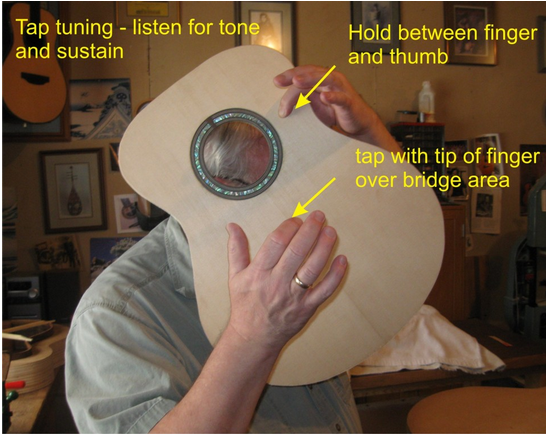
Acoustic guitar designers far smarter than I have argued (sometimes in my presence) about “Tuned Tops”, the controversial idea being that guitar soundboards may be carefully sanded in order to emphasize a desired inherent note, or “Peak Resonant Frequency”. I only refer to that debate on my way to talking about what really matters in life: AMPLIFIERS. 
But first, Coke bottles. Blow across the top of a coke bottle (or one of my Uncle Leo’s moonshine jugs), 

and you’ll get a note. Sure, the note will contain harmonics, overtones, and whatnot, but a note of determinate pitch will be mostly what you hear. Increase the cavity size by “removing” some of the corn  liquor, (first, give your cell phone to a friend for safekeeping), and the note gets lower. This is a Helmholtz Frequency.  Guitars demonstrably have them, it’s just that it takes an air compressor gun to blow across the top of the soundhole with sufficient “oomph”. 
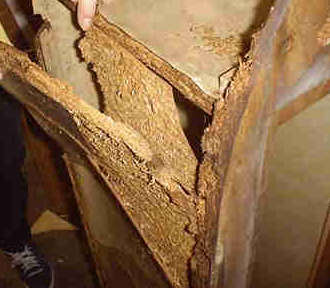
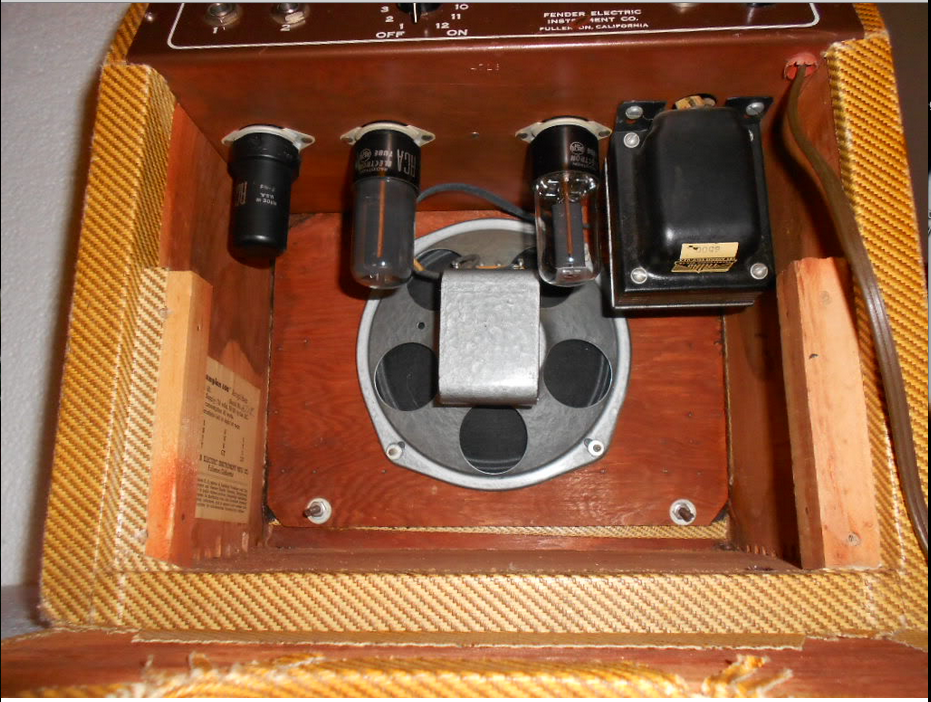
How you’d blow across an amp cabinet to make a Helmholtz note, I have no idea. But what with the soft yellow pine (now many decades old) that pre-CBS Fender amps are made of, and their floating baffles, and their open backs… these old amps practically dance around when played at or near full blast.
Jim Marshall’s iconic 1960 4×12” cab is made from far stiffer baltic birch ply. The speakers originally available to Jim were really 15-watters, so he needed four twelves to survive the output of his JTM45. The closed back, fixed-baffle* cab is actually airtight, providing speaker-protecting air suspension, and reduced excursion (pumping to-and-fro). 
I gigged for years with an open-back Marshall Bluesbreaker which really sounded like a Fender. That closed-back 4×12 cab is a key tone ingredient. 
Particle board came into common use as amp/speaker cabs  long after the Golden Age. It’s cheap, endlessly plentiful, and has none of the resonant qualities of finger-jointed Pine or Birch Ply. Apart from the SIGNIFICANT musical advantages of eschewing glue ‘n sawdust speaker cabs, that particle board crap “out gasses” formaldehyde, hastening the demise of the planet while generating inferior tone.
I recommend finger-jointed pine for combos, or Baltic Ply for cabs. If you buy a really old one, you’re saving a tree, as well as reaping the sonic benefits of decades of the wood drying out and vibrating. Manufacturers of particle board may chase me down and club me, but their crappy bats will crumble to dust with one crack of my noggin. 


*on 1960 cabs, the baffle board to which the speakers are mounted is attached all the way around, unlike Fender’s tacked-only-at-the-four corners, or “floating baffle”

My Favorite Guitar; Drew Berlin’s 1956 Les Paul Custom

BURST BROTHERS: COLLECT THE WHOLE SET!

Two of ’em, actually.
Dave Belzer let us (Okay, ME) check out his 1959 Burst (See below), and now Drew Berlin is up on the boards with his Honey Baby, a 1956 Les Paul Custom, fitted with 2 real PAFs. Ay, Carumba.

This stick has a pedigree that would make your head swim, including Drew’s 10 years with the Originator, Little Richard.

Whoooooooooooooooooooo, indeed.

SOME LES PAUL CUSTOM INFO…
Nowadays, beginning with the reintroduction in 1968 after seven-odd years in mothballs, The LPC is pretty much a Standard with an ebony fingerboard and fancier trim.
It was not always thus.
From late 1953 until on or about the end of 1960, Customs were one huge hunk of mahogany. No maple cap. With just a paltry handful of exceptions, the early ones had a unique P90/ Alnico set of pickups, while the last three years of the run featured THREE PAF hum buckers. Many, I for one, have longed for a 2 PAF fifties Custom.

 Drew has one. This one.

NOTA BENE Dave Belzer has a conventional 3 pickup Custom which is  just a couple of serial numbers apart from the one Clapton used with Lennon in Toronto, with Delaney and Bonnie, and elsewhere.

MY FAVORITE GUITAR Dave Belzer’s ’59 Burst

Dave Belzer is half of the legendary “Burst Brothers”. Along with Drew Berlin, they have played, appraised, brokered, owned, and played more BIG vintage guitars than anyone on the west coast, or possibly anywhere. They are my friends, and, MAN, do they love AUTHENTIC guitars. I cannot imagine having to pick just one favorite from the man’s private stash. Sophie’s Choice. Here’s what he picked…

If MY house catches on fire, I’m going to drive over to Belzer’s house to make sure HIS guitars are safe. Can’t be too careful. 

MY FAVORITE GUITAR Mat Koehler’s 1944 Epi FT-79

Writer, musician, collector, wheeler-dealer, and connoisseur of objets d’art (Especially old motor oil signs), Mat Koehler is a man of exceptional taste in guitars. 
 He has a special affection for pre-Gibson Epiphones.

BETCHA DIDN’T KNOW
Gibson and Epiphone were rivals, BITTER rivals, prior  to 1957, the year Gibson absorbed the smaller, New York-based, company. It’s said that the outgoing Epi employees staged a bonfire of guitar bodies and necks on their way out of the factory en route to the unemployment office. Get a load of Mat’s 1944 flattop. Wartime production was almost illegal, making this an almost impossibly rare bird.

 Some acoustics seem to have been sprinkled with magic dust. This is one.

So I sent this to a bunch of my no-good guitar playin’ buddies:

Among those who responded are The Burst Brothers (Dave Belzer and Drew Berlin), Bob Mothersbaugh (AKA Devo’s Bob 1) Steve Lukather, Mat Koehler, Chuck Kavooras, Arnie Newman, Brian Kahanek, and Holland K Smith.


I’ll be shooting their segments soon. Meantime, you have to start somewhere. So I started in my bedroom. 
SPOILER ALERT: My Favorite Guitar is gaudy and twangy.